“The Threads That Connect Us; Echoes of Time.”
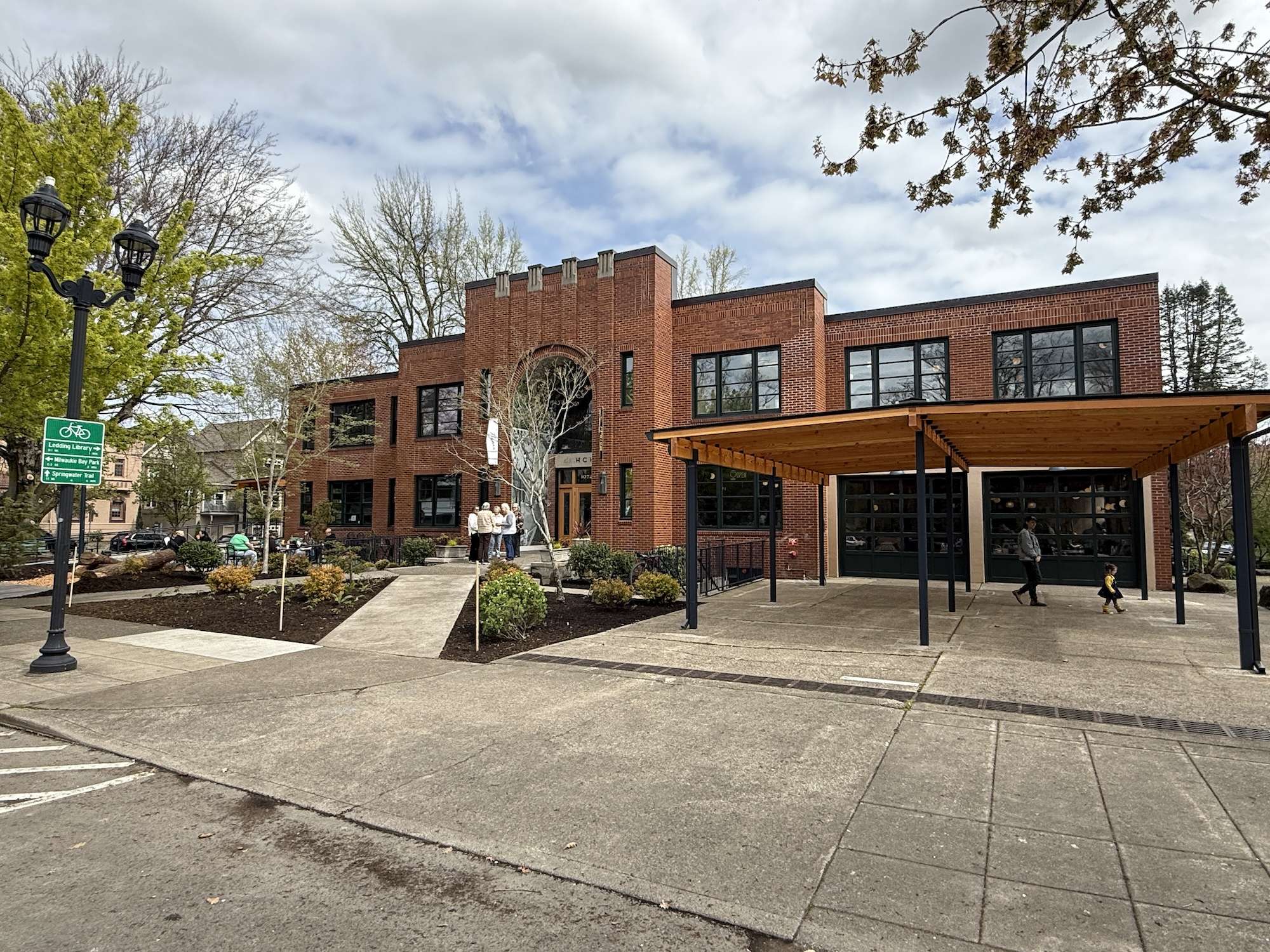
The Historic Milwaukie City Hall is now open and chock-full of local art!
ABOUT THE PUBLIC ART PROJECT
Join the Clackamas Arts Alliance in celebrating the opening of the renovated Historic Milwaukie City Hall, now adorned with public art! This initiative, titled “The Threads That Connect Us; Echoes of Time,” was a collaborative effort involving the Milwaukie community and various other partners.
ABOUT THE PUBLIC ART PROJECT: Using art to interpret the philosophical, conceptual, and nostalgic qualities of how time passes from the geographic qualities of the Willamette River’s terrain to the anthropologic blip of humans living and tending to this place (Milwaukie, OR and the surrounding 15-mile radius), AND where it may take [us] in the next 100 years (est. 2125 AD).
Context for this theme’s inspiration recognizes that this land (Milwaukie, OR) has been home to diverse caretakers and inhabitants for millennia, and that rivers are regularly referenced as metaphors for passing time. A 1938 Time Capsule was discovered during the redevelopment process which is tangible evidence for how fleeting time truly is. This project’s theme seeks to add to this treasure by utilizing the multiple art installations as story-telling opportunities for this region’s histories, [our] contemporary period, and predictions for what Milwaukie’s future may become.
This theme is not intended to limit concepts to historical representations. Rather, Artists are encouraged to learn about the region, draw upon its long history of life and evolution, and stretch their imaginations to create new and diverse interpretations for Milwaukie’s past, present and future.
The Steering Committee for the Public Art endeavor was composed of Milwaukie Residents and Business Representatives, including the incoming project retail tenants.
Opened with an RFQ Phase, the project received 56 eligible applicants. The Steering Committee then advanced 7 of those applicants into the RFP Phase wherein artists submitted site-specific designs based on the project’s Theme. After thoughtful consideration and a hearty deliberation, the Steering Committee selected 2 incredible, Oregon-based Artists – Aya Morton and Cameron Holly Dexter – for Zone 1: Exterior Arch and Zone 2: Interior Stairwell installations. Their custom designs are now installed and the building is open.
GALLERY NOW OPEN:
Historic Milwaukie City Hall
10501 SE Main St.
Milwaukie, OR 97222
This Project is supported by the collective contributions of:
- Henry Point Development
- City Hall Holdings, LLC
- City of Milwaukie
- Celebrate Milwaukie
- Autzen Foundation
- Clackamas Arts Alliance
Learn more about the Project Developers:
ABOUT THE ARTISTS & INSPIRATIONS


Aya Morton (Zone 1, Exterior Arch)
Aya grew up in rural Oregon, where she discovered her passion for stories and drawing; studied at Brown University, where she majored in religious studies; and traveled extensively in Southeast Asia. She then received an illustration degree from the ArtCenter College of Design and has worked as a freelance artist in London, England, and Portland, Oregon, where she now lives with her family.
Aya is a lover of travel and the multiple perspectives gained by different cultures, landscapes, and historic eras. Aya’s work includes The Great Gatsby: The Graphic Novel, (illustrator), The Days Are Long, the Years Are Short , (picture book, author-illustrator), and has been featured in Comics Art, by Paul Gravett through Tate Publishing, exhibited in the London House of Illustration, and has received recognition and awards from Communication Arts, 3×3 Illustration Annual, and the World Illustration Awards.
This archway mural is inspired by Milwaukie’s rich, botanical heritage. The first people of what is present day Milwaukie harvested Wapato tubers, a wetland plant with broad green leaves and elegant white flowers, as well as gooseberries, pine nuts and acorns. With its fertile soil near the Willamette River, Milwaukie went on to thrive in agriculture. Fruits and vegetables were produced from farms and orchards, including strawberries, celery, and peaches. The Bing Cherry, now the most widely cultivated sweet cherry in the country, originated in Milwaukie in 1875, and was developed by local horticulturalist, Seth Lewelling and his foreman, Ah Bing.
Milwaukie’s most iconic tree, however, was a towering Pacific Dogwood that earned the city the nickname ‘The Dogwood City of the West’ for being the largest of its kind in the world. Though the historic dogwood was damaged in a storm and came down in 1962, Milwaukie continues to celebrate this legacy by planting young Dogwood trees and shrubs, including in front of the old City Hall building. These natural emblems, core to Milwaukie’s history and identity, remind us of the rich past and future potential.
Visitors to the building are invited to enter through the archway of a seasonal canopy. To either side, Milwaukie landscapes of the Willamette River and streets combine contemporary views with the outlines of historic vessels and vehicles, (The 1850 Lot Whitcome sidewheeler, and a 1958 MFD fire engine), framing the viewer in a sense of place. The shadows of Wapato grow to the right, and a new Dogwood tree is planted to the left. As the two sides rise up, the seasonality of the trees, as well as saturation of color, build through spring and summer, finally receding towards fall again in the top of the arch. This seasonal passage reminds us of Milwaukie’s past, present, and future and the constant, regenerative cycle of old things becoming new.
Paintings for this mural were originally created using acrylic ink on paper. Layers of color washes were painted separately so that they could include both positive and negative shapes and line, then digitally overlayed on the original painting.
Cameron Holly Dexter (Zone 2, Interior Stairwell)
Cameron Holly Dexter is a collage artist, muralist, and filmmaker originally from New Hampshire, who now calls the Pacific Northwest home. Growing up surrounded by nature shaped her creative perspective, fostering a deep appreciation of history, storytelling, and the connections between people and their environment.
Her visual art blends analog and digital collage, often incorporating archival imagery, cosmic elements, and vibrant woodland vignettes. Her compositions also explore themes of time, nature, and memory. Whether showing art at a gallery or working on a large public mural, she aims to create work that sparks curiosity and conversation.
In addition to her visual art, she is a seasoned filmmaker. Her films have been featured at top festivals, including SXSW, Sundance, and Tribeca. Her film work often explores narratives of resilience, identity, and untold histories. Across both mediums, she’s drawn to stories that challenge perceptions and bring overlooked perspectives to the forefront. Through
art and film, she seeks to bridge eras, honor history, and create meaningful connections between people and their communities.
She thanks the many people who shared their stories, historical images,
and time with her throughout this process.
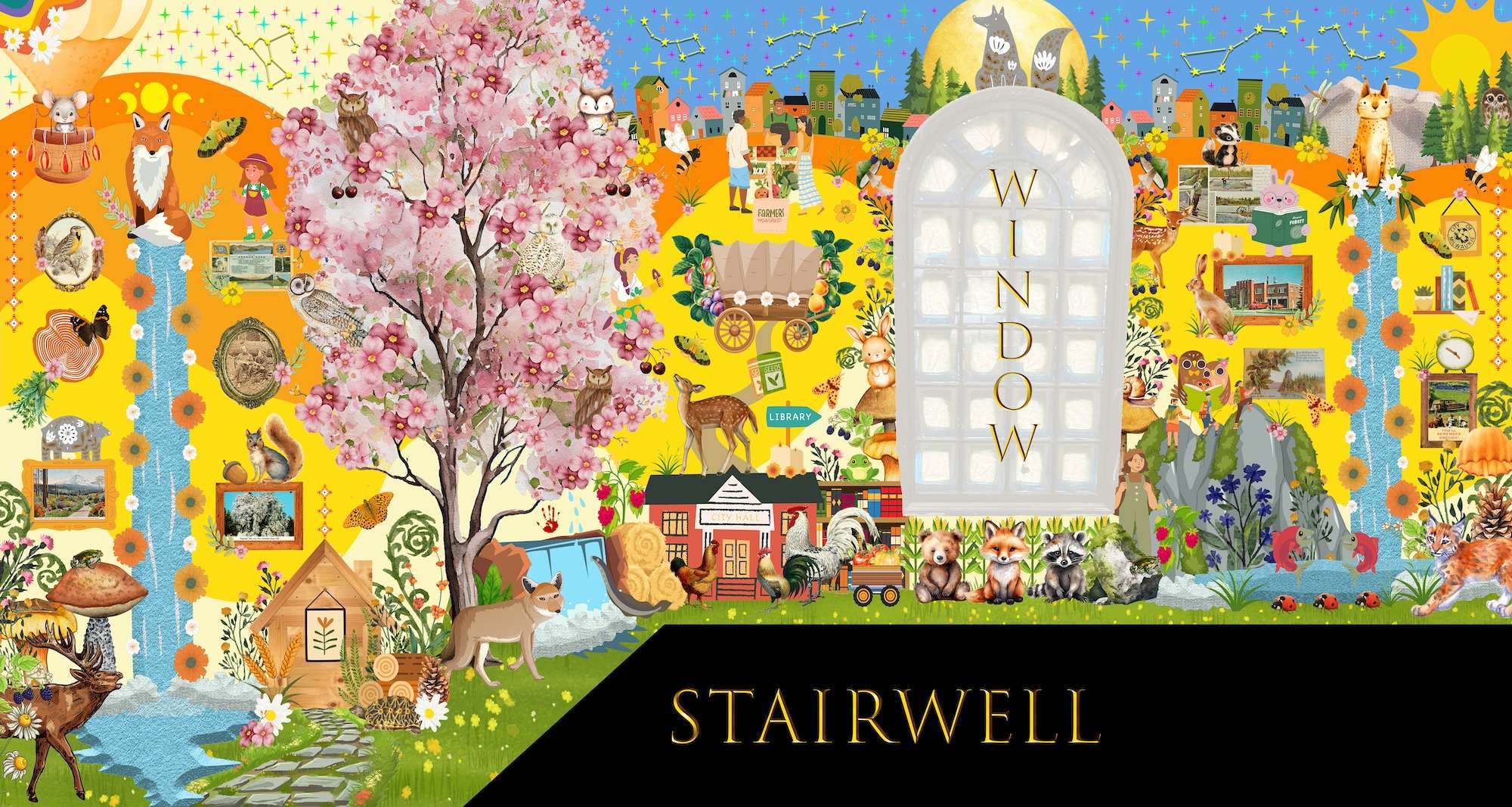
The stairwell mural for Echoes of Time: The Threads That Connect Us is a tribute to the rich history, natural beauty, and cultural heritage of Milwaukie, Oregon. This mural is an immersive narrative woven with symbols that honor the land, its people, and the passage of time— celebrating the interconnectedness of past, present, and future.
At the heart of this piece is the Pacific dogwood tree, a symbol of resilience and identity for the city. Once, Milwaukie was home to the world’s largest Pacific dogwood, a towering presence that stood over 65 feet tall with a seven-foot-wide trunk. In 1962, this remarkable tree inspired the city’s official moniker, “The Dogwood City of the West.” The mural pays homage to this legacy, recognizing the deep roots that shape a place and its people.
Bing cherries, another essential part of Milwaukie’s story, represent the region’s agricultural innovation. Cultivated in 1878 by pioneer nurseryman Seth Lewelling, the Bing cherry was named after Ah Bing, a Chinese orchard worker whose contributions were vital yet often overlooked in historical narratives. Their story is a reflection of the hands that have long tended this land—immigrants, laborers, and visionaries who have left a lasting imprint.
The passage of time, represented by cascading waterfalls. Water serves as a visual representation for how history and stories continue to move, shaping the present while carrying echoes of the past.
Nestled beneath the dogwood trees is a traditional plank house, paying tribute to the Clackamas people, the Chinookan-speaking Indigenous group who have lived in this region since time immemorial. These cedar-plank homes were not only places of shelter, but also centers of community and culture. These homes reflect the deep relationship between the first people of the Clackamas region, and the abundant land and waterways of the Pacific Northwest.
A covered wagon, bursting with fruit trees, represents Seth Lewelling’s pioneering spirit and the agricultural abundance he helped cultivate. When the Lewelling family arrived in Milwaukie from Iowa in 1847, they brought a combination of over 700 varieties of seeds, grafted fruit trees, berries and nuts. This journey would turn out to be the foundation for the region’s thriving agriculture and fruit industry. This imagery speaks to the boundless potential carried by those who journeyed west in search of a new home and a fertile future.
Throughout the mural, woodland creatures appear, bringing a sense of joy and wonder—especially for the younger generations who will walk these stairwells. These animals, native to the area, invite curiosity and a connection to nature, serving as gentle reminders that the land holds stories beyond human history.
Finally, Tomanowos, the Willamette Meteorite, looms as a symbol of the ancient and the celestial. This massive 15.5-ton meteorite, the largest ever found in North America, was discovered on Clackamas land before being illegally removed in 1905. Now housed at the American Museum of Natural History, it remains a poignant testament to displacement— both of people and sacred objects—and the ongoing dialogue about reclamation and respect for Indigenous heritage.
By blending archival imagery with nature-inspired elements, this mural invites viewers to engage with history in a meaningful way while reflecting on the threads from long ago that continue to connect us all.
SPECIAL THANKS:
Cameron would like to extend her gratitude to the following:
- Confederated Tribes of the Grand Ronde
- The Museum of Flight
- Oregon Historical Society
- Oregon Encyclopedia
- Oregon Queen History Collective
- Walt Luelling
- Clackamas Arts Alliance
- Miracle Sign Co.
- Raziah Roushan

THANK YOU TO OUR CONTRIBUTORS!
This Project is supported by the collective contributions of:
- Henry Point Development
- City Hall Holdings, LLC
- City of Milwaukie
- Celebrate Milwaukie
- Autzen Foundation
- Clackamas Arts Alliance
Learn more about the Project Developers: